
Introduction
Pinterest vs Facebook Comparison is a massive part of our daily lives, but not every platform serves the same purpose. Facebook is the world’s largest social network, built to help you connect with friends, family, and communities through news, videos, and personal updates. On the other hand, Pinterest functions more like a visual search engine or a digital mood board where people go to find inspiration for recipes, home decor, and DIY projects. While Facebook focuses on who you know, Pinterest focuses on what you want to do or buy in the future.
Have you ever wondered why you spend hours scrolling through Facebook but head straight to Pinterest when you need to plan a wedding or a kitchen remodel? The difference lies in your mindset. Facebook is where we go to be social and catch up on the latest news, whereas Pinterest is where we go to be productive and dream up new ideas. Choosing between the two isn’t just about which app has more users; it’s about understanding which environment fits your specific goals, whether you are sharing a life milestone or hunting for your next big project.
In this comparison, we will dive into the latest 2026 data to see how these giants stack up. We’ll look at the staggering 3.07 billion monthly users on Facebook versus the highly intentional 619 million on Pinterest. You’ll discover how Facebook’s diverse, global reach compares to Pinterest’s unique, female-forward demographic. By looking at engagement rates, advertising costs, and user intent, we will help you decide which platform deserves more of your time and energy.
Pinterest vs Facebook Comparison: Overview
Pinterest vs Facebook Comparison is the undisputed giant of the social media world. As of early 2026, it boasts over 3.07 billion monthly active users, reaching nearly every corner of the globe. People use it primarily to stay in touch with friends, join community groups, and watch viral videos. It is a social-first platform where the main goal is connection. Because of its massive size, it is a go-to for marketers who want to reach a wide and diverse audience.
Pinterest operates differently, functioning more like a visual search engine than a social network. It currently has about 619 million monthly users who visit the site to plan for the future. Instead of looking for news or updates from friends, “Pinners” search for inspiration on home decor, fashion, and DIY projects. This makes Pinterest a high-intent platform. While Facebook is great for sparking a conversation, Pinterest is where people go when they are ready to take action or make a purchase.
Pinterest vs Facebook Comparison: Audience & User Stats
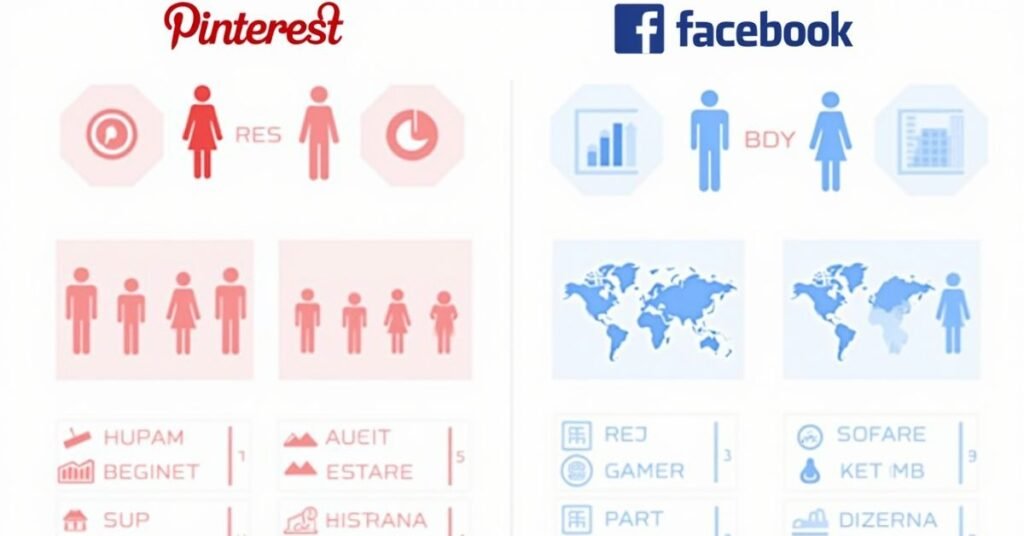
Pinterest vs Facebook Comparison is the giant of the social media world with a massive, diverse community. As of 2026, it has over 3.07 billion monthly active users, which is nearly 40% of the world’s population. It is especially popular with adults aged 25–34, who make up its largest age group. While many people think of it as a place for older generations, the data shows that young adults and professionals are still the most active. Unlike some other apps, Facebook has a slightly higher percentage of male users, though it remains a primary hub for almost every demographic to connect and share.
Pinterest operates on a smaller but much more specific scale. It has reached approximately 619 million monthly active users, and its audience is famously unique. About 70% of Pinterest users are women, making it a powerhouse for brands focusing on home, fashion, and lifestyle. While its total user count is lower than Facebook’s, the people on Pinterest are highly motivated. They don’t just scroll to see updates; they use the platform like a search engine to plan future purchases. This means that while Facebook offers huge reach, Pinterest offers a deeply focused audience ready to take action.
| Feature | ||
| Monthly Active Users | 3.07 Billion | 619 Million |
| Primary Gender | 56.6% Male / 43.4% Female | 70% Female / 23% Male |
| Largest Age Group | 25–34 (Millennials) | 25–34 (Millennials) |
| Average Daily Time | ~67 Minutes | ~14 Minutes per session |
| Top Global Market | India (450M+ users) | United States (90M+ users) |
| Primary User Intent | Socializing & Community | Discovery & Planning |
| Shopping Behavior | Product Discovery (Ads) | Intent-based Search (Planning) |
Ad Formats Compared: Pinterest vs Facebook
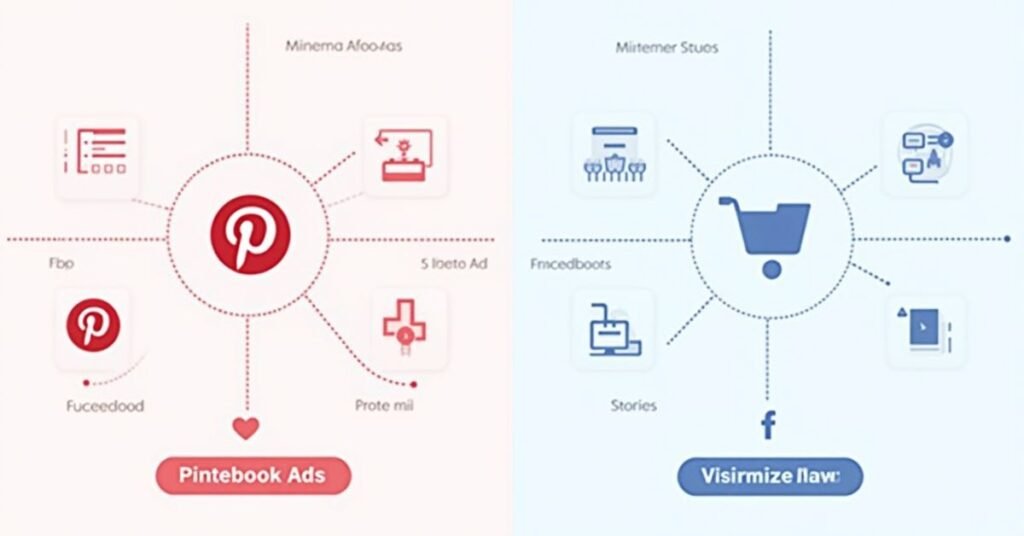
Pinterest vs Facebook Comparison offers a huge variety of ad styles to help you grab attention while people are browsing. You can use simple Image Ads, Video Ads, or Carousel Ads that let users swipe through different products. In 2026, Story Reels and AI-driven Advantage+ campaigns have become the top choice for many, as they use short, vertical videos to keep people engaged. Facebook ads are great because you can add a lot of text to explain your product, helping you convince someone to buy even if they weren’t planning to shop.
Pinterest ads look much more like regular content, which helps them blend in naturally. The most common format is the Standard Pin, but you can also use Idea Ads and Video Pins to show off tutorials or “how-to” guides. One of the coolest features in 2026 is the AR Try-On Ad, which lets users virtually test products like makeup or home decor using their camera. While you can’t write long paragraphs like you can on Facebook, Pinterest ads are powerful because they reach people who are already in a “planning mode” and ready to spend.
| Ad Format | Facebook (Meta) | |
| Main Style | Interruptive (Feeds & Stories) | Discovery (Search & Boards) |
| Best Visuals | Short Reels & UGC Videos | Vertical Images & Tutorials |
| Text Options | High (Long captions allowed) | Low (Focus on the image/overlay) |
| Interactive | Polls & Instant Experiences | AR Try-On & Quiz Ads |
| Shopping | Advantage+ Catalog Ads | Shoppable Pins & Collections |
| Lifespan | Short (Lasts while ad runs) | Long (Can be saved & seen later) |
Pinterest vs Facebook Comparison: Costs & ROI
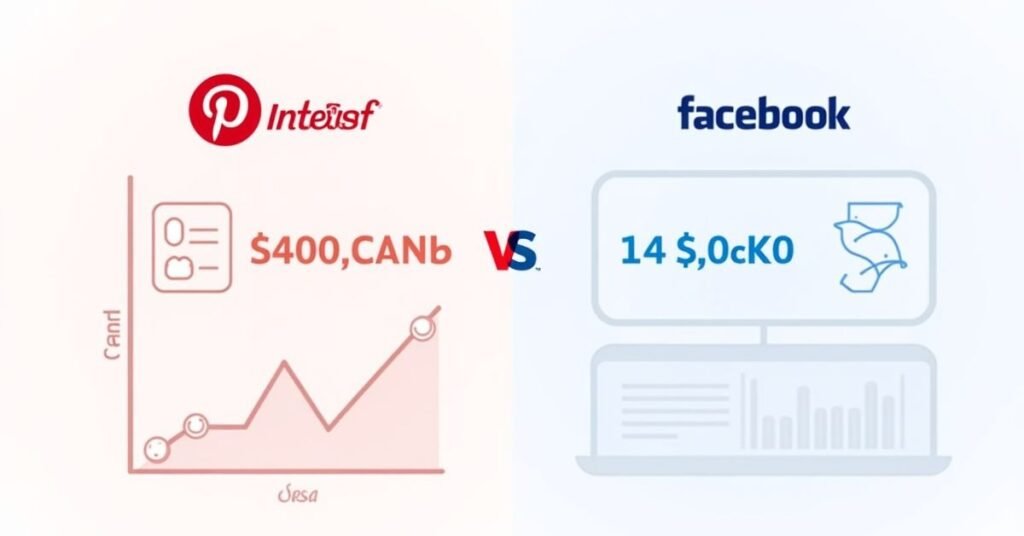
Pinterest vs Facebook Comparison advertising is often the first choice for businesses because of its massive scale and powerful AI. In 2026, the average Cost Per Click (CPC) on Facebook ranges from $0.50 to $1.50, depending on how competitive your industry is. While it can be more expensive than Pinterest, Facebook offers a very high Return on Investment (ROI) because its targeting is so precise. It excels at finding people who have already visited your website or shown interest in your brand, making it a leader for closing sales and generating leads.
Pinterest is frequently praised for being more affordable and offering a unique, long-term value. With a lower average Cost Per Thousand Impressions (CPM) of around $2.00 to $5.00, it is an excellent place for brand discovery. What makes Pinterest stand out is the “shelf life” of its ads; while a Facebook ad stops working the moment you stop paying, a Pinterest ad can be “saved” to a user’s board and continue driving free traffic for months. For visual brands in fashion or home decor, Pinterest often delivers a 32% higher Return on Ad Spend (ROAS) compared to other social platforms.
| Metric | Facebook (Meta) | |
| Average CPC | $0.50 – $1.50 | $0.10 – $1.50 |
| Average CPM | $8.00 – $14.00 | $2.00 – $5.00 |
| Typical Monthly Budget | $500 – $2,500+ | $200 – $1,500+ |
| Conversion Rate | ~8.25% (High for leads) | ~2% – 5% (Higher for luxury/home) |
| Average Order Value | Moderate | 50% Higher than other social apps |
| Ad Lifespan | Short (Hours/Days) | Very Long (Weeks/Months) |
| Primary ROI Driver | Precision Retargeting | Visual Discovery & Planning |
Pros & Cons of Pinterest vs Facebook
Choosing the right platform depends on your specific business goals. Facebook is a powerhouse for broad reach and community building. Its massive user base of over 3 billion people means your audience is definitely there. However, it is a “pay-to-play” environment, meaning your organic posts rarely reach many people without an ad budget. While its targeting is incredibly advanced, the high competition can make it expensive to stand out in a crowded news feed.
Pinterest offers a unique advantage because it works like a long-term search engine. A single “Pin” can drive traffic to your website for months or even years, whereas a Facebook post usually dies out in a few hours. It attracts a high-income audience that is already in a “buying mindset,” which often leads to a higher return on investment for visual brands. On the downside, Pinterest has a smaller total audience and is still very heavily focused on female users, which might not fit every business niche.
Key Takeaways
- Facebook Pro: Unmatched global reach and the most advanced AI targeting available in 2026.
- Facebook Con: Organic reach is very low; you almost always need to pay for ads to be seen.
- Pinterest Pro: Pins have a very long lifespan and continue to drive free traffic long after you post them.
- Pinterest Con: The audience is smaller and more niche, focusing mostly on lifestyle, home, and fashion.
- Facebook Pro: Excellent for building communities and having two-way conversations with customers.
- Pinterest Pro: Users spend significantly more per order than on almost any other social platform.
When to Use Pinterest vs Facebook
Choosing between these two platforms depends on what you want to achieve right now. Facebook is your best choice if you need to reach a massive, diverse audience quickly or if you want to build a community. It is the perfect place for “interruptive” marketing, where you catch someone’s eye with a great video or a trending news story while they are browsing. If your business relies on local services, event sign-ups, or direct conversation through comments and messages, Facebook’s advanced AI will help you find those customers effectively.
Pinterest is the clear winner when your business is highly visual or focused on “the future.” Because it works like a search engine, you should use it to reach people who are in the planning stage of a project. It is ideal for e-commerce brands in niches like home decor, fashion, DIY, and travel. If you want your content to have a long life, Pinterest is the place to be; a single Pin can continue driving traffic to your store for months after you post it. Use Pinterest when you want to reach high-intent shoppers who are looking for inspiration and are ready to buy.
Best Use Cases
- Choose Facebook for:
- Building a loyal community or a Facebook Group for your brand.
- Promoting time-sensitive events, flash sales, or local business updates.
- Advanced retargeting to bring back people who visited your website.
- Reaching a broad demographic across all age groups and locations.
- Choose Pinterest for:
- Selling products that look great in photos (lifestyle, food, home).
- Driving consistent, long-term traffic to a blog or an online store.
- Targeting people based on specific search keywords rather than just habits.
- Reaching shoppers who have a higher-than-average household income.
Case Studies: Pinterest vs Facebook Campaign Results
Real-world results from 2025 and 2026 show that both platforms can be highly profitable if used correctly. For example, fashion and home decor brands on Pinterest have seen a 6.2:1 Return on Ad Spend (ROAS). This is because users on Pinterest often have a 40% larger “basket size” at checkout compared to other apps. One major retailer reported that their cost to acquire a customer was up to 50% lower on Pinterest than on other channels because they reached shoppers right when they were searching for new ideas.
Pinterest vs Facebook Comparison continues to win when it comes to sheer volume and speed. Recent case studies show that while Pinterest is great for planning, Facebook is the king of the “impulse buy.” Brands using Facebook’s Advantage+ AI tools have seen a 3.8:1 ROAS on average across all industries. Because Facebook can reach such a massive audience so quickly, it remains the top choice for companies that want to scale their sales fast. While the costs are rising, the ability to retarget customers who almost bought something makes it a vital tool for most businesses.
Pinterest vs Facebook Comparison: Future Trends 2026
In 2026, Facebook is doubling down on “social search” and AI-driven communities to keep users engaged. The platform has updated its feed to look more like a full-screen, immersive video grid, making Reels and live shopping the main ways people discover new brands. AI now handles almost all the heavy lifting for advertisers by automatically matching ads to the right people based on real-time interests. Instead of just scrolling through updates from friends, users are increasingly using Facebook to find local groups, join niche hobby circles, and shop directly through interactive, AI-powered catalogs.
Pinterest is evolving into a high-tech “personal assistant” for your future plans. By 2026, it has fully integrated Augmented Reality (AR) “Try-On” features that let you virtually place furniture in your home or test makeup before buying. The platform is focusing on “grounded optimism,” where users move away from noisy social feeds to spend time in a private, creative space. Trends are moving faster than ever, and Pinterest’s new predictive tools allow businesses to see what will be popular months in advance. The goal is to make the path from “finding an idea” to “buying the product” completely seamless within the app.
Conclusion
Choosing between Facebook and Pinterest depends entirely on your specific goals. If you want to build a community, talk to customers, and reach a huge variety of people, Facebook is your best bet. It is the king of social connection and works incredibly well for grabbing attention quickly. For most businesses, it remains the foundation of their social media presence because of its massive scale and powerful AI tools.
On the other hand, Pinterest is the perfect place if you want to inspire people who are ready to take action. It works more like a library of ideas than a social network, making it ideal for visual brands and long-term traffic. While Facebook is about the “now,” Pinterest is about “what’s next.” By using both platforms together, you can cover all your bases—from meeting new people on Facebook to helping them plan their future purchases on Pinterest.
FAQs
1. Which platform is better for driving immediate sales?
Facebook is generally better for quick sales because its AI targeting is designed to find “impulse buyers” who are ready to click and buy right now.
2. Does Pinterest or Facebook have a higher cost for advertising?
Facebook usually has a higher Cost Per Click (CPC), while Pinterest offers a cheaper Cost Per Thousand Impressions (CPM) and longer-lasting value for your money.
3. Can I use the same content for both platforms?
It is not recommended; Facebook works best with social, conversational posts and Reels, while Pinterest requires high-quality, vertical images that act as helpful “how-to” guides.
4. Which platform is better for reaching a male audience?
Facebook is the better choice here, as its user base is split more evenly between genders, whereas Pinterest’s audience remains about 70% female in 2026.
5. How long do posts stay “active” on each site?
A Facebook post usually loses its reach within 24 hours, but a Pinterest Pin is evergreen and can continue to show up in search results for months or even years.

Welcome to Digital Pin Media! I’m Usama Ijaz, an AI-Powered SEO, and Content Write with 4 years of experience.
I help websites rank higher, grow traffic, and look amazing. My goal is to make SEO and web design simple and effective for everyone.
Let’s achieve more together!