Introduction
A Marketing Hooks is a short, catchy phrase or idea used at the very beginning of an ad or post. Think of it as a “digital bait” designed to grab someone’s attention in a split second. Its main job is to stop people from scrolling and make them curious enough to read or watch more.
Have you ever wondered why you click on some videos instantly while ignoring others? It is usually because a powerful hook sparked an emotion or promised a solution to your problem. In a world where everyone is fighting for attention, a weak start means your great content stays invisible.
In this article, we will explore how specific types of hooks can transform your social media presence. From using “curiosity gaps” to addressing “pain points,” these strategies are the secret to boosting your reach and conversion rates. You will learn exactly how to craft words that turn random scrolls into loyal customers.
What Makes a Marketing Hook Effective?
An effective hook works because it connects with human psychology instantly. It usually offers a quick solution to a problem or creates a “curiosity gap” that makes you want to know more. When a hook feels personal and relatable, people naturally stop scrolling to see what you have to say. It is not about being loud; it is about being relevant to the right person at the right time.
Simplicity is another secret to a great hook. Using clear, easy language helps your message land faster than a complex sentence ever could. A good hook also uses strong emotions, like excitement or even a little bit of FOMO (fear of missing out). If your first sentence makes someone feel something, they are much more likely to engage with your entire post.
How to Use This Marketing Hooks Guide
To get the most out of this guide, start by identifying your main goal. Whether you want more likes or more sales, pick a hook that fits your specific objective. Don’t try to use “Avoid trying to implement all strategies at the same time.” Instead, choose one style and adapt it to your brand’s unique voice so it feels authentic to your followers.
Once you pick a hook, test it out on different platforms to see what works best. Pay attention to which phrases get the most comments or clicks. “Incorporate these lessons to keep your content dynamic and effective.” Remember, the best way to master these hooks is to keep practicing and tweaking them until they feel natural.
Problem–Solution Marketing Hooks
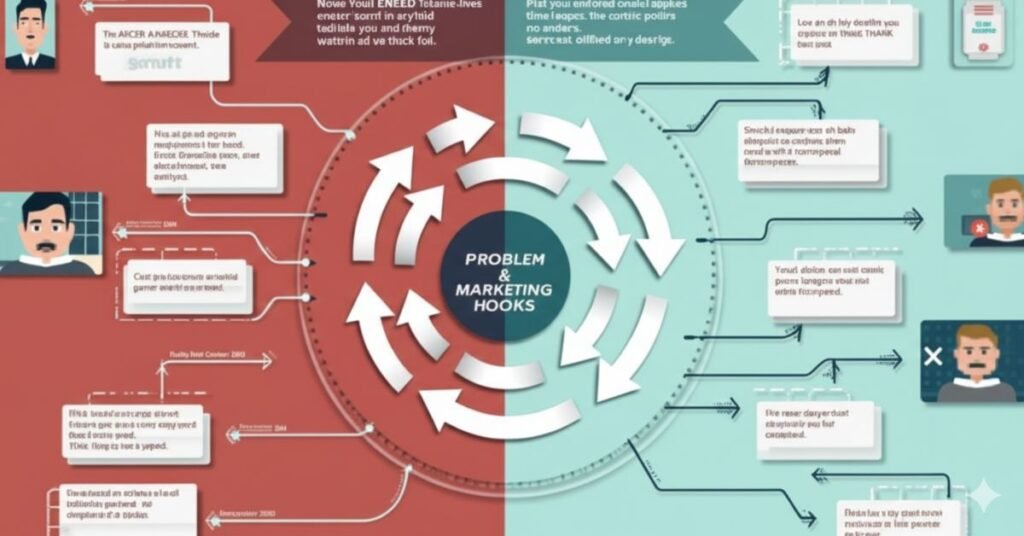
Problem-solution hooks work because they address a specific struggle your audience is facing. First, you name a common frustration that keeps them up at night. Then, you immediately offer a glimpse of the answer. This approach builds instant trust because it shows you actually understand their daily challenges. People pay attention when they feel someone has a shortcut to their success.
To make these hooks effective, keep the problem relatable and the solution simple. You want to agitate the pain point just enough to make them want a way out. By positioning your content as the “missing piece,” you turn a random viewer into an interested lead. It is one of the fastest ways to prove your value without sounding like a pushy salesperson.
Here are a few examples you can use:
- “The Struggle: Putting in hours on content that gets ignored.”
- The Quick Fix: “Stop guessing what to post. Use this 3-step formula instead.”
- One mistake: led to 10k followers for me.
Curiosity-Driven Marketing Hooks
Curiosity-driven hooks work by opening a loop in the reader’s mind that they feel the need to close. “Give only a glimpse of the story to spark your audience’s curiosity and make them wonder how it unfolded.” or “Why? “This method sparks curiosity by revealing what’s been kept hidden.”“Hinting at a secret or shortcut naturally grabs people’s attention.”“This content is incredibly captivating, keeping viewers hooked from start to finish.” you won’t want to scroll away.”
The key to a great curiosity hook is to be specific but mysterious. You don’t want to be “clickbaity” or dishonest, as that ruins trust. Instead, highlight a surprising result or an unconventional method that goes against common knowledge. By challenging what people think they know, you grab their full attention and pull them deeper into your content.
Try these curiosity-boosting examples:
- What top creators do differently that nobody talks about.”
- The “Wait, What?” Factor: “Why I stopped posting every day (and actually grew faster).”
- “The Unexpected Result: I tried this 5-minute hack for a week, and the outcome blew me away.”
- The Counter-Intuitive Tip: “Most people think SEO is dead, but they are looking at it all wrong.”
Benefit-Driven Marketing Hooks
Benefit-driven hooks focus entirely on the “what’s in it for me” factor. Instead of talking about features or technical details, you lead with the positive result the user will get. These hooks work well because they paint a clear picture of a better future. When people see a headline that promises a specific improvement in their life or business, they are much more likely to stop and listen.
To make these hooks work, you must be very specific about the reward. Don’t just promise “success”—promise a “20% increase in sales” or “saving two hours every day.” By highlighting the end goal right away, you cut through the noise and grab the interest of people who are ready to take action. It is the most direct way to show value and build excitement for your brand.
Here are some benefit-focused examples:
- “The Quick Fix: Learn video editing in 10 minutes using these easy templates.”
- “Step-by-Step: Guide to Landing High-Paying Clients on LinkedIn.”
- “More energy all day, no extra coffee required.”
- “The Simple Approach: Craft professional emails that get results.”
Social Proof Marketing Hooks

Social proof hooks are powerful because people tend to follow what others are doing. When you show that hundreds or thousands of people have already tried and loved your product, it removes doubt. These hooks act as a “seal of approval” from the real world. Instead of you saying you are great, you let the crowd prove it for you. This creates instant credibility and makes new followers feel safe joining in.
Using numbers and real results makes these hooks even more effective. People trust facts and success stories more than generic promises. When you highlight a testimonial or a milestone, you are telling the reader that your method actually works. It turns a “maybe” into a “yes” because nobody wants to miss out on something that everyone else is benefiting from.
Check out these social proof examples:
- “Join our weekly: Growth tips community of 5,000+ entrepreneurs.”
- The Success Story: “See how Sarah doubled her revenue in just 30 days using this strategy.”
- This tool has a 5-star rating from over 1,000 satisfied users.
- The Expert Nod: “The exact framework used by top Fortune 500 marketing teams.”
Seasonal and Trend-Based Marketing Hooks
Seasonal hooks take advantage of what is happening in the world right now. Whether it is a holiday, a change in weather, or a viral news story, these hooks feel fresh and urgent. They work because they connect your message to the current “mood” of your audience. When you talk about something that is already on everyone’s mind, your content feels much more relevant and timely.
To use trend-based hooks, you need to act quickly. Trends move fast, so you want to jump on a popular topic while people are still talking about it. This shows your audience that your brand is modern and active. It is a great way to get a sudden boost in views because social media algorithms love to promote content that uses trending keywords and topics.
Here are some seasonal and trend-based ideas:
- The Holiday Angle: “The only 3 gifts every tech lover wants this Valentine’s Day.”
- Here are some simple steps you can take to prepare for the Q4 rush.”
- “What brands can learn from the success of viral Super Bowl commercials.”
- The New Year Goal: “Forget 2025. Here is how to dominate your niche in 2026.”
100 Marketing Hooks for Your Content
Having a list of ready-to-use hooks can save you hours of frustration. You don’t always need to reinvent the wheel to get attention. Most viral posts use a few proven formulas that tap into curiosity or a specific benefit. By keeping a library of these hooks, you can focus more on creating great content and less on worrying about the first sentence.
Below is a categorized list of hooks designed to stop the scroll. You can adapt these to almost any niche by simply filling in the blanks. Use them for your reels, blog posts, or email subject lines to see which ones your audience likes best. Remember, the best hook is the one that feels most natural to your brand’s voice.
100 Marketing Hooks
| Category | Hook Template / Idea |
| Curiosity | “Insider info on [Topic].” Curiosity |
| Curiosity | “I gave [Trend] a try, so you can skip it.” |
| Curiosity | 3. “Stop doing [Common Habit] if you want [Result].” |
| Curiosity | 4. “The secret tool that changed my life.” |
| Curiosity | “Most fail at [Task]—here’s how to get it right.” |
| Problem/Solution | 6. “Tired of [Pain Point]? Read this.” |
| Problem/Solution | 7. “How to fix your [Problem] in under 5 minutes.” |
| Problem/Solution | 8. “The easiest way to [Goal] without [Struggle].” |
| Problem/Solution | 9. “Struggling with [Topic]? Here is the solution.” |
| Problem/Solution | “Struggle with [Task]? Here’s something you’ll love.” |
| Benefit | 11. “How to get [Desirable Result] today.” |
| Benefit | 12. “3 steps to doubling your [Metric].” |
| Benefit | 13. “The fastest way to learn [Skill].” |
| Benefit | 14. “Unlock your full potential in [Area].” |
| Benefit | 15. “Get [Benefit] while you sleep.” |
| Social Proof | 16. “Why 10,000 people use [Product].” |
| Social Proof | “The proven method I used to hit [Milestone].” |
| Social Proof | 18. “What I learned from [Expert/Famous Person].” |
| Social Proof | 19. “Our most popular [Service] is finally back.” |
| Social Proof | 20. “See why this went viral last week.” |
| Urgency | 21. “Don’t wait until [Topic] is too late.” |
| Urgency | 22. “Only 24 hours left to grab this.” |
| Urgency | 23. “Here’s why starting [Task] now is essential.” |
| Urgency | 24. “The window is closing on [Opportunity].” |
| Urgency | 25. “Stop scrolling if you want to save [Time/Money].” |
| Educational | 26. Lessons about [Topic] I wish I’d known sooner.” |
| Educational | 27. “A beginner’s guide to [Complex Subject].” |
| Educational | 28. “The truth about [Common Myth].” |
| Educational | 29. “5 tools you need to master [Niche].” |
| Educational | 30. “How I [Result] with zero experience.” |
Women-Owned Marketing Agencies in Winnipeg: Why They Matter
Supporting women-owned marketing agencies in Winnipeg is more than just a social gesture; it is a smart business move. These agencies bring a fresh and inclusive perspective that helps brands connect with a wider audience. Because women make the majority of household spending decisions, having a female-led team can give your marketing a competitive edge. They understand the nuances of consumer behavior in a way that feels authentic and trustworthy.
In Winnipeg’s growing economy, these agencies also play a vital role in community building. They often prioritize collaboration and empathy, which leads to stronger long-term relationships between clients and their customers. By choosing to work with them, businesses help foster a more diverse and innovative marketplace. It is a win-win situation where your brand grows while also supporting local entrepreneurship and gender equality.
Here is why partnering with them makes a difference:
- Diverse Insights: They offer unique viewpoints that help your brand stand out in a crowded market.
- Targeted Expertise: Many specialize in high-growth areas like wellness, sustainable brands, and social impact.
- Economic Impact: Hiring local, women-led firms keeps investment within the Winnipeg community.
- Authentic Connection: They excel at creating messaging that resonates deeply with female consumers—the world’s most powerful shoppers.
What Is a Digital Marketing Hook?
A digital marketing hook is the very first thing your audience sees or hears. It is usually a single sentence, a bold headline, or a striking image at the start of your content. Its only goal is to grab attention and stop someone from scrolling past your post. Think of it as a firm handshake that introduces your brand and makes people curious about what comes next.
In the fast-paced world of social media, you only have about three seconds to make an impression. A good hook acts like a magnet that pulls the reader into your story. Without a strong opening, even the best content can go unnoticed. By using a hook, you are giving your audience a clear reason to stay, listen, and eventually engage with your message.
Origins of Digital Marketing Hooks
The idea of a “hook” didn’t start with the internet. It actually comes from the early days of newspaper ads and radio. Copywriters in the 1920s knew they had to use bold headlines to grab attention in a busy street. They studied human psychology to figure out which words made people stop and look. These early techniques laid the foundation for how we capture interest today.
As television and magazines became popular, hooks evolved into catchy jingles and bright visuals. When the digital age arrived, these old strategies moved online. In a world of infinite scrolling, the old “headline” became the digital hook we use on TikTok and Instagram. Even though the technology has changed, the goal remains the same: to spark instant curiosity in a crowded world.
How Digital Marketing Hooks Work
Digital marketing hooks work by triggering a specific reaction in the human brain. When we see something unexpected or highly relevant, our brain stops its “autopilot” mode. The hook creates a momentary pause that demands focus. It basically interrupts the mental habit of scrolling and forces the person to evaluate if the content is worth their time.
Once the hook grabs the attention, it must bridge the gap to the rest of your content. It promises a reward, like a laugh, a lesson, or a solution to a problem. If the hook is successful, the reader moves from being a passive observer to an active participant. It is the crucial first step in a journey that leads from a simple click to a loyal customer.
Here is the step-by-step process of how they work:
- Pattern Interruption: It breaks the visual or mental rhythm of the user.
- Emotional Connection: It sparks a feeling like curiosity, fear, or excitement.
- Value Promise: It hints that the reader will gain something by staying.
- The Transition: It leads the user naturally into the main body of your message.
How to Write an Effective Marketing Hook
Writing a great hook starts with knowing exactly who you are talking to. You need to identify a specific desire or a problem your audience has right now. Instead of being vague, use “power words” that paint a clear picture in their minds. A good trick is to write the hook last, after you have finished your content, so it perfectly matches your message.
Keep your sentences short and punchy for the best results. You want to deliver the main idea as fast as possible before the reader moves on. Avoid using “corporate speak” or boring introductions that everyone has heard before. If your first sentence sounds like a real person talking to a friend, people will be much more likely to trust you and keep reading.
Follow these simple steps to write yours:
- Start with the “Why”: Tell the reader exactly why they should care in the first five words.
- Use Action Verbs: Words like “Stop,” “Build,” or “Discover” create a sense of movement.
- Keep it Simple: Use words that a 5th grader would understand to ensure your message is clear.
- Test Multiple Versions: Write three different hooks for one post and see which one feels the strongest.
Conclusion
Mastering the art of the marketing hook is a total game-changer for your digital presence. It is the bridge that connects your great ideas to the people who need to see them. By using the different styles we discussed, you can stop the scroll and start building real connections. Remember, even the best content needs a strong opening to get the attention it truly deserves.
Feel free to experiment and test new ideas when crafting your headlines. Not every hook will be a massive hit, but each one is a chance to learn what your audience loves. Keep your language simple, stay authentic, and always focus on providing value from the very first second. With a little practice, writing catchy hooks will become a natural and powerful part of your marketing routine.
FAQs
1. What is the most effective type of marketing hook?
The most effective hook depends on your audience, but Curiosity and Problem-Solution hooks generally get the highest engagement because they trigger an immediate emotional response.
2. How long should a digital marketing hook be?
A good hook should be short and punchy, ideally between 5 to 15 words, so it can be read in under three seconds.
3. Can I use the same hook for different platforms?
Yes, but you should tweak the tone; for example, keep it more professional for LinkedIn and more casual or energetic for TikTok and Instagram.
4. Why is my hook not getting any clicks?
It might be too vague or sound too much like an advertisement. Try to make it more personal and focus on a specific benefit for the reader.
5. Is a “hook” the same as “clickbait”?
No, a hook is a genuine promise of what’s in your content, while clickbait is often misleading or dishonest just to get a click.

Welcome to Digital Pin Media! I’m Usama Ijaz, an AI-Powered SEO, and Content Write with 4 years of experience.
I help websites rank higher, grow traffic, and look amazing. My goal is to make SEO and web design simple and effective for everyone.
Let’s achieve more together!